Fourth Floor , Plot no 104 , OPP Tulip residency , Road no 2 , Kakateya Hills , Guttala Begumpet ,Hyderabad.

EV Charging Point Operators (CPO’s) Market in India

EV Charging Point Operators (CPO’s) Market in India

EV Charging Point Operators (CPOs) Market in India: State-wise Opportunity Mapping, Unit Economics, and Competitive Landscape.

EV Charging Point Operators Market In India

EV charging infrastructure refers to public and semi-public charging stations that supply electric energy to electric vehicles across urban, semi-urban, and highway environments. The market includes AC chargers, DC fast chargers, ultra-fast chargers, and associated energy management systems deployed across city clusters, fleet hubs, and intercity corridors.

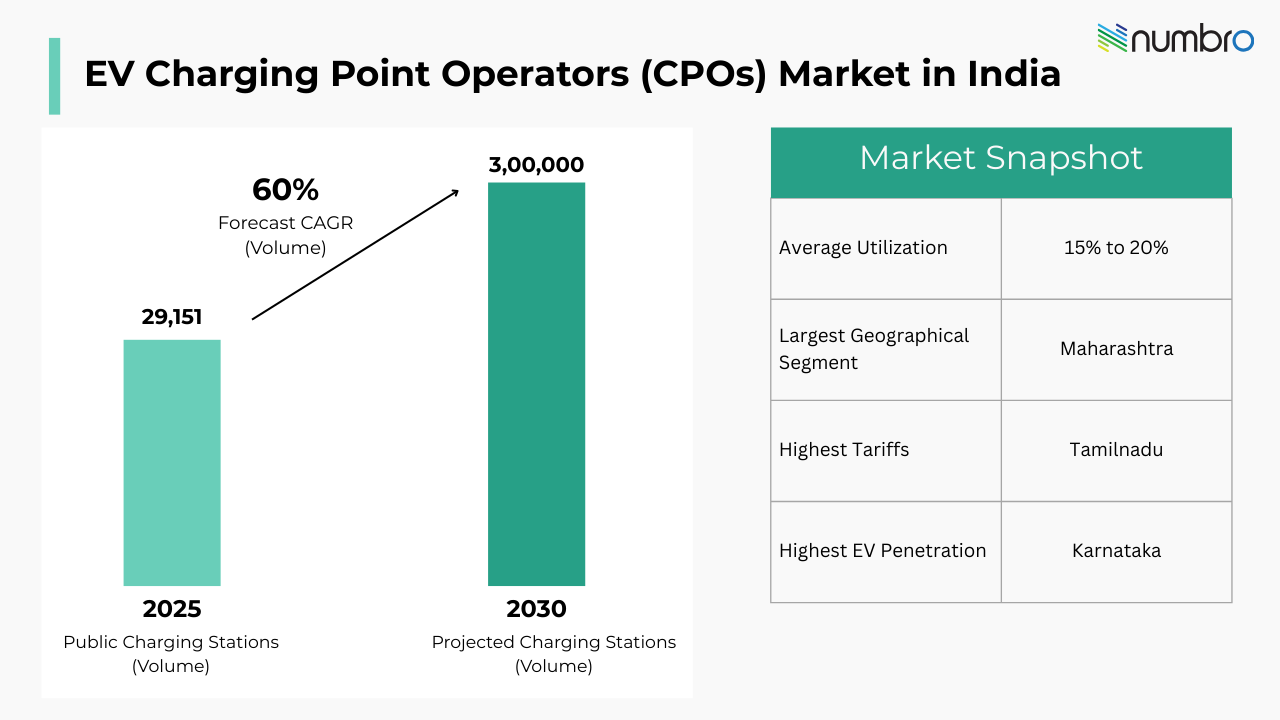
The India EV charging point operators market has expanded rapidly between 2022 and 2025 and is now transitioning from installation-led growth to utilisation-driven expansion. Market performance is influenced by EV penetration levels, state-level policies, grid readiness, tariff structures, corridor electrification mandates, and fleet integration trends.
Largest & Fastest Growing Segments

DC fast charging forms the core of the market, emerging as the dominant revenue driver due to its alignment with higher-power and high-utilisation use cases. Demand is primarily concentrated in four-wheelers and commercial vehicles, as these segments generate significantly greater energy throughput compared to smaller personal mobility categories. Market value remains clustered in leading EV-adoption states, reflecting stronger policy continuity, urban density, and fleet presence, while CCS2 has established itself as the prevailing connector standard across fast-charging infrastructure.

Looking ahead, growth momentum is increasingly shaped by the continued expansion of fast-charging networks, the rising contribution of emerging states beyond traditional leaders, the scaling of commercial and fleet-based applications, and the ongoing consolidation toward globally standardised connector technologies.

Market Dynamics

The India EV charging infrastructure market is supported by rising EV adoption, strong policy backing, corridor electrification mandates, and expanding fleet usage across logistics and public transport. However, moderate utilisation levels, grid constraints, tariff variation across states, and high capital costs for fast-charging infrastructure continue to impact site viability. The industry is gradually shifting from rapid installation growth toward utilisation-driven expansion, with increasing emphasis on corridor deployment, fleet integration, and unit-level economic sustainability. corridor classification (immediate, growth, white-space), and technology integration (CMS, smart charging, solar integration, battery swapping, ultra-high-power and bidirectional systems).

Market Segmentation

The India EV charging infrastructure market is segmented by charging type (AC, DC fast, ultra-fast), vehicle segment (2W, 3W, 4W, commercial/fleet), connector type (CCS2, Type-2 AC, Bharat DC-001, CHAdeMO), geography (state-level analysis),

Regional / State Analysis

Charging deployment is concentrated in a limited number of states, with significant disparity in charger density and EV-per-charger ratios across regions. Leading states show higher infrastructure maturity, while several states remain underpenetrated, indicating expansion opportunities over the forecast period.

Investment Landscape

The sector experienced peak funding during 2022–2023 followed by capital normalisation. Investment focus is shifting from rapid infrastructure expansion toward utilisation efficiency, revenue per charger, and state-level economic viability.

Key Questions Addressed by the Report

  • What is the projected growth trajectory of India’s EV charging infrastructure market through 2030?
  • How will revenue growth compare with charging point expansion over the forecast period?
  • Which charging types are expected to generate the highest market value?
  • Which vehicle segments will drive the majority of charging demand by value?
  • How concentrated is market share across leading states, and which regions offer emerging growth potential?
  • Where do state-level supply and demand gaps exist based on EV-to-charger ratios and charging density?
  • How will highway expansion and corridor electrification influence deployment patterns?
  • What factors determine site-level profitability, including utilisation, grid access, and vehicle mix?
  • How does variation in state electricity tariffs impact charging economics and return profiles?
  • What is the evolving competitive and investment landscape, and how is capital allocation shifting within the industry?


For more details, please fill this form

    w

    Lorem ipsum dolor sit amet, consectetur adipiscing elit eiusmod tempor

    w

    Talk to Us

      SME IPO advisory services for growth

      Full Report

      Full Report

      Full Report

      Full Report

      Full Report

      Full Report

      Full Report

      Full Report

      Full Report

      Full Report

      Full Report

      Full Report

      Full Report

      Full Report

      Full Report

      Full Report

      Full Report

      EV Retrofitting Market

      EV Battery Reuse & Repurposing Market

      Telematics & Fleet Management Software (FMS) for Commercial EVs

      Battery Swapping Infrastructure

      EV Recycling & End-of-Life Vehicle (ELV) Scrappage Ecosystems

      The Indian EV Insurance & Risk Underwriting Market

      Retail EV Financing & Micro-Mobility Credit

      Battery Energy Storage Systems (BESS) for CPO Hubs

      Decentralized Renewable Energy (DRE) Integration in EV Charging

      EV Testing, Inspection & Certification (TIC) Services

      EV Thermal Management Systems (VTMS)

      Semiconductors & Power Electronics for Indian EVs

      EV Passenger Fleet Market

      The EV passenger fleet market — encompassing cab aggregator electrification, corporate shuttle fleets, and airport taxi pools — is reshaping urban mobility economics in India. BluSmart’s all-EV model has demonstrated proof-of-concept; incumbents like Ola and Uber are accelerating electrification targets.

      What Numbro Covers:

      • Market size and forecast for EV passenger fleets by city tier and operator type
      • Business model deep-dive: driver-owner vs aggregator-owned vs Fleet-as-a-Service (FaaS)
      • Driver economics and unit economics comparison: EV vs CNG vs petrol
      • Charging infrastructure requirements and turnaround time analysis
      • Competitive landscape: BluSmart, Evera, Lithium Urban, Zoomcar EV transition

      Ideal for mobility startups, ride-hailing platforms, automotive OEMs, and urban mobility-focused funds.

      Domestic Electric Motor & Powertrain Manufacturing

      Electric motors and powertrains are the mechanical heart of every EV. India’s domestic manufacturing capability in this space is expanding rapidly — yet significant import dependence on China for high-torque motors, inverters, and transmission components persists. The opportunity for domestic Tier-1 suppliers is enormous.

      What Numbro Covers:

      • Market mapping: PMSM, BLDC, induction motor applications across 2W, 3W, 4W, and commercial segments
      • Domestic vs imported content analysis — indigenisation roadmap by segment
      • Powertrain system benchmarking: integrated vs modular architectures
      • Key players: Sona BLW, HPEV, Turno, Altigreen, Greaves Cotton, KPIT Technologies
      • Investment opportunity sizing in motor winding, rare-earth magnets, and controller manufacturing

      This research is designed for component manufacturers, engineering firms, and strategic investors evaluating deeptech EV component plays in India.

      EV Commercial Fleet Market

      India’s commercial EV fleet market — spanning last-mile delivery, intercity freight, and intracity logistics — represents one of the fastest electrification curves in Asia. Driven by e-commerce growth, rising diesel costs, and ESG commitments from major corporates, fleet electrification is no longer optional.

      What Numbro Covers:

      • Segmentation by vehicle class: L5 (cargo 3W), SCV, LCV, MCV, HCV
      • Total Cost of Ownership (TCO) modelling vs diesel — breakeven timeline by use case
      • Fleet operator profiling: Mahindra Last Mile, ElectrifyIndia, BluSmart Mobility, Euler Motors fleets
      • Charging depot infrastructure requirements and financing models
      • Corporate ESG procurement mandates driving fleet electrification demand

      This report is built for logistics companies, fleet leasing firms, EV OEMs, and investors positioning in the commercial mobility transition.

      EV Battery Manufacturing Market

      India’s EV battery manufacturing landscape is undergoing a structural transformation. The Production Linked Incentive (PLI) scheme for Advanced Chemistry Cells (ACC) has catalysed over ₹18,000 crore in committed investments, with Ola Electric, Reliance, Amara Raja, and Exide leading the charge.

      What Numbro Covers:

      • Competitive benchmarking of ACC PLI awardees — capacity, technology roadmaps, timelines
      • Cell chemistry analysis: LFP vs NMC vs sodium-ion — relevance for Indian conditions
      • Import substitution opportunity: cathode, anode, electrolyte, separator supply chain gaps
      • Gigafactory feasibility — capex, opex, IRR, land, power, and water requirements
      • Global OEM partnerships and technology licensing trends

      This market intelligence is essential for chemical companies, materials suppliers, foreign OEMs, and PE/VC funds evaluating battery manufacturing exposure in India.

      EV CPO Market

      India’s Charging Point Operator (CPO) market is at a critical inflection point. With the government’s push under FAME III and state-level EV policies mandating charging infrastructure build-out, the CPO segment is transitioning from a subsidy-dependent model to a commercially viable business.

      What Numbro Covers:

      • Total addressable market sizing by geography, charger type (AC/DC/Fast), and vehicle segment
      • Revenue model benchmarking — per-unit, subscription, white-label, B2B fleet contracts
      • Mapping of 50+ active CPOs including Tata Power, Ather Grid, Statiq, ChargeZone, EESL
      • Policy deep-dive: Bureau of Energy Efficiency (BEE) standards, interoperability mandates, tariff regulations
      • Investment landscape — VC/PE funding flows, strategic M&A activity

      Our research enables investors, infrastructure developers, and fleet operators to identify the highest-yield CPO deployment geographies and business models across India’s Tier 1, 2, and 3 markets.

      Talk to Us

        SME IPO advisory services for growth